‘What Does It Mean’ Monday #5 “Choking the Chicken”

Yep. You read right.

Today I am doing something a bit different. Sure I am going to be exploring the above phrase and its origins, but rather than basing my research on online google searches, I am going to say right now, what I am about to say can’t be found on google.

I AM GOOGLE TODAY PEOPLE. You won’t find this info anywhere.

I am going to bring forth a theory based on someone else’s fact, and so if you disagree with me, I’d love to hear it… but I think it’s pretty darn good.

Since I talk about origins, of course I can’t proceed without talking about what my Monday phrase first means. So, how do I put this…

‘Choking the chicken,’ diplomatically speaking, is the act of pleasuring oneself, intimately…

With the term specifically reserved to men. For good reason.

Think similar terms like “taking the dog for a walk,”

“spanking the monkey” and

“bashing the bishop.”

And if you still have NO IDEA what I am talking about, you clearly should not be on this blog.

Onwards for those that do.

With the phrase well and truly explained and the image clear in our minds (sorry!) I will now go onto the fascinating story of HOW I CAME TO FIND OUT ITS ORIGIN.

And guess what? Real chickens are involved.

william-moreland-auijD19Byq8-unsplash

Photo by William Moreland on Unsplash

Some time ago we were visiting some family friends, who had backyard chickens at the time. Baby girl being the age she is, was fascinated with the chooks, and our friend caught some for her to pat.

As he held one, he was telling us about the chooks, and how he had to sometimes… choke them. Not choke as in strangle, but massage the area beneath the hen’s neck which is called the ‘crop,’ which if it became watery and squishy in nature, might mean the food they had eaten had not emptied fully, which could lead to an infection for the hen.

To keep this from happening – he laughed – he had to “choke the chicken.”

At first I stared in awe. I mean, the term kind of went over me, as I stared, watching him massage the neck of the hen, up and down, until something, slowly and quietly, spewed and dribbled out from the hen’s mouth.

Oh God. Then it hit me. 

CHOKE. THE. CHICKEN.

The official term used is ’emptying a chicken’s crop.” Look it up on youtube. Hell, I’ll give you the link that I watched. Go to 4:20. There you go, easy peasy pumpkin easy. And then watch as the chicken… well, you know.

I must advise, only those that know what they are doing should perform this manoeuvre. You can fatally harm a chicken if you don’t do this the right way. But as you can see in the video… OMG. Like it looks, the same! Oh God. I feel sick. Please don’t vomit guys, don’t vomit.

And there you have it. Choking the chicken. Bet you didn’t see that one coming.

Okay I will stop now.

Is there a phrase or quote you want me to investigate?

Let me know, and I’ll give it a go!


Decorating like a Rebel

Doughnuts. Read, dough-nuts.

And then some people say donuts. Do-nuts. I can be a grammer nazi all I like, but when it comes down to it, if someone is gonna give you an opportunity to decorate delicious doughnuts and then take them home for a very reasonable price, well they can call them DO-NUTS all they like.

Insert school holidays. Insert Rebel Donuts. These guys do these decorating classes each school holiday break, and for $9.50 which includes the online processing fee (at the time of this writing) you can book yourself in to decorate not one, but two doughnuts!

Ok… so I may have omitted something here, but…

It’s for your kidshhh. (Find one for the session if you don’t have one).

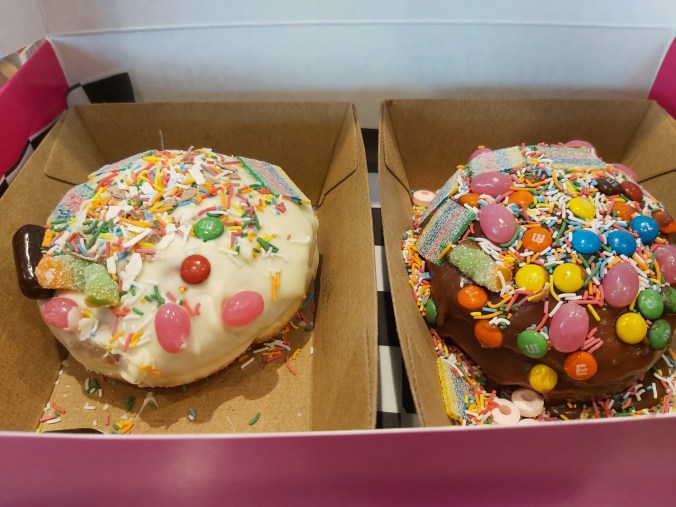
You (or your child) get to pick the filling – think nutella, caramel, cookies and cream, jam – and then the topping, which could be your doughnut dipped in white or milk melted chocolate, and then… you decorate to your hearts content!

20190928_110732

Think mini m&ms, sprinkles, chocolate licorice, hard candy and soft jellies… it’s a candy-lovers paradise!

These classes run most mornings during the week, and last for half an hour. Considering most doughnuts are about $4 and you are getting 2, customised to taste, and then further personalised by yours truly to pretty up… well it’s a pretty awesome deal.

20190928_110910

And then you go home. And you eat it. NOM NOM NOM NOM NOM.

You can find Rebel Donuts at 968A Nepean Highway Mornington

Find details of their school holiday classes via rebeldonuts.com.au

Now we just need an adult decorating doughnut class… waiting patiently here…

(And you can read more about Rebel from my first intro into their doughnut world – tee-hee – here) 😉

Life Rules by SmikG #1 About wine and being shitty in reply

Keep this list handy…

#1 Don’t write/email/respond to someone who has pissed you off, while you are still pissed off… and drinking wine.

BAD IDEA.

james-jadotte-twwa0zmMGSI-unsplash

Photo by James Jadotte on Unsplash

Explanation: In my online writing course the students give each other feedback on our 5000 word submissions. The other day I was totally cranky pants and thrown off by one such student who thinks they are smarter than the teacher (why are you doing this course then?)

I didn’t like their disparaging and condescending remarks to my submission, and then, the student got the entire plot of my story wrong!

Like, why comment on something and tell me you don’t believe it, when you didn’t read my synopsis properly in the first place! GRR ARGH!

So I stewed… and I stewed…

And I drank some wine…

And I stewed some more…

And then still shitty (and still sipping on red)…

I took the wine to the computer…

And I wrote a reply.

(Insert snapping dogs and cats clawing at one another).

I was diplomatic in my reply. Sure. But now, a few days after, I’m feeling…

BAAA. 🐑

Sheepish.

Why did I let someone I don’t even know get to me?

Note rule number 1!


‘What Does It Mean’ Monday #4 “Dead on Time”

I’m squeezing this one in tonight. Before the witching hour begins.

Have you heard that one before? About that freaky time between midnight and 3am where spooky things and odd disturbances are more likely to occur? Well I’ve got another one for you. Because I want to break down the above post title, but also, I am going to throw in my own interpretation if you will allow me to.

Dead on Time. Literally we are talking about ‘time.’ But why do people get all morbid and say “dead on”?

Well the “dead on” part means literally – “absolutely”

“precisely”

“exactly.”

Combine them and you get the meaning “precisely on time.”

The word “dead” on its own finds its way into other phrases. Things like:

Dead still

Dead quiet

Dead serious

Dead drunk

What can we take from these?

Well, the dead are still

The dead, are quiet

Death, is serious.

And if you get too drunk, you can be mistaken for dead

But, what about that phrase I mentioned, “dead on time.”

Sure, it means exactly on time.

But I am about to go further and I’ll apologise right now for getting so morbid on you.

ahmad-ossayli-laJW5pp-6Yw-unsplash

Photo by Ahmad Ossayli on Unsplash

Many years ago I wrote a blog post called “Dead on Time.” It followed 3 funerals I attended in a matter of weeks. It made me think a lot, and I came to reflect on some similarities.

I believe dead on time is dual in its meanings. It has another one.

The living are late. And the dead can’t wait.

The funerals I’ve been to always run to time. There is no one living to hold the proceedings up. A wedding will have a bride whose hair didn’t go to plan, a nervous groom pacing the floor at his parents home, but meanwhile, at a funeral…

Sadly, all is said and done.

And though those who have passed may be on their way to another realm, another world, there is nothing to stop them on their journey…

And therefore they are dead on time.

Right? Wrong? Or so, so wrong?

Is there a phrase or quote you want me to investigate?

Let me know, and I’ll give it a go!

‘What Does It Mean?’ Monday #3 “Easy peasy pumpkin easy”

I have only ever known it as ‘pumpkin easy.’ But my daughter insists, every time I say it this way, that it is in fact – “lemon squeezy!”

I honestly thought it was her stubborn nature as she often proves herself to be 6, going on 17 and all… until I did this google search…

“EASY PEASY…”

And the “lemon squeezy” result came up far more times than my “pumpkin easy” preference did!

It must be a generational thing. Hubbie too finished my testing ‘easy peasy’ opener with –

PUMPKIN EASY.

Ok, so besides who says it what way, what does it actually mean?

Simple. Like literally. It means super easy or extremely simple.

“See, we fold this here and there you go! Easy peasy pumpkin easy.”

“We turn right into this street and it’s there – easy peasy lemon squeezy!”

The original term is easy peasy. Common add ons can be:

Pumpkin easy, or

Lemon squeezy, or even

Japanese-y!

WHAT?!

orlova-maria-aO76xjr6xow-unsplash

Photo by Orlova Maria on Unsplash

The latter part of the sentence contains playful words added on perhaps for the fact that it is often used in the company of children (hence my almost everyday use of it). It is an example of a rhyming duplication… think other examples like teenie-weenie, and super-duper.

The term ‘easy peasy’ was originally used in the 1940 American film called The Long Voyage Home. We can only guess at the lemon squeezy addition, with some believing it goes back to a British commerical for soap in the 50s-60s, where the slogan used was “easy peasy lemon squeezy” to promote its lemon-scented dish soap called “Sqezy” (pronounced squeezy).

America’s version was ‘easy as pie,’ used as far back as from 1976, but we can still see that the British term was in use much further back than when the US one arrived on the scene.

I for one, have no idea where the pumpkin came in… only to assume that it may have digressed from the ‘easy as pie’ expression, and someone thought that pumpkins (and their pies!) were easy… hence ‘easy peasy pumpkin easy’?

As for the ‘Japanese-y’ addition… a few sources cite that it comes from a silly childhood rhyme:

“Easy peasy Japanese-y

Wash your hair in lemon squeezy!”

Why I never. I can imagine there was more rhyming and schoolyard nonsense attributed to this version rather than a downright racial slur… but fair to say I will still be using the orange vegetable version thank you very much!

Do you sayeasy peasy”? Which version do you use?

Is there a phrase or quote you want me to investigate?

Let me know, and I’ll give it a go!


Baby girl says the darndest things #6

I have the most interesting conversations with baby girl, who is 6 going on 17.

She knows everything, and expects me to read her mind.

This from a while ago.

It is morning.


“Honey, why was your door open this morning? Did you open it?”

“Yes.”

“You opened it and then went back to sleep?”

“I had to go toilet.”

“Did you go?”

“No I was waiting for you.”

PAUSE. “Did you call me?”

Hands in air. “I was standing here waiting for you!” Indicates the door.

“Honey how can I help you when you don’t call me? I was sleeping.”

“Mama! You should have known!”

(Face palm).

“Ok, so did you go toilet then?”

“No.”

“Do you have to go now?”

“No.”


I give up. 🤯


‘What Does It Mean?’ Monday #2 “Don’t get your knickers in a knot”

The above phrase is also commonly referred to as –

“Don’t get your knickers in a twist.”

“Don’t get your panties in a knot”

“Don’t get your panties in a bunch.”

Collectively they all mean the same thing…

Don’t get too excited or upset, or

Calm/settle down.

fahad-waseem-AdjyrNhFVPI-unsplash

Photo by Fahad Waseem on Unsplash

There doesn’t appear to be a real definitive origin of the phrase, other than to say that the term “don’t get your knickers in a twist” appears to have come from Britain in the 70s, only to have moved along to the U.S and Australia and become their version of “don’t get your knickers in a knot.”

The term ‘knickers’ itself is a British one, and the phrase is primarily reserved for women and their lower apparel…

Although the first recorded literary mention seems to come from Wilbur Smith’s The Train from Katanga (1965) I have to quote the 1968 novel by Frank Norman, titled Barney Snip – Artist:

“Oh do stop it,” she gasped as their lips broke away from each other with a resounding plonk. “You’re getting my knickers in a knot!”

And that my friends, is an appropriate usage of the term ‘knickers in a knot’ don’t you think? 😉😂

(How’s about that ‘lips broke away … with a resounding plonk’! What is a plonk sound? How do lips parting, go plonk? Hmm). 🤔

Is there a phrase or quote you want me to investigate?

Let me know, and I’ll give it a go!

‘What Does It Mean?’ Monday #1 “Hold Your Horses”

Have you ever wondered at the term “hold your horses?” I say it a lot, primarily to baby girl being the impatient 6 year-old that she is, and to our cat Mister F, well because… he can’t wait for anything and meows incessantly when he wants something.

It makes simple sense if you stop to think about it. In a historical sense, it refers to keeping your horses or carriage from moving and holding them still, and this is interpreted in our every day speech to mean:

to not get ahead of ourselves

to not rush

to be careful, and

to not celebrate too early.

“Hold your horses, we’re not there yet.”

“Hold your horses, you don’t know what is around the bend.”

“Hold your horses, you haven’t won the game.”

“Hold your horses, have another think about what you just said…”

daniil-vnoutchkov-FwK07kj-mTc-unsplash

Photo by Daniil Vnoutchkov on Unsplash

First said as “hold your hosses,” it became our modern day interpretation in references like from the magazine Chatelaine in 1939, with –

“Hold your horses, dear.”

Is there a phrase or quote you want me to investigate?

Let me know, and I’ll give it a go!


I don’t have time for this

Time. People think money is the biggie… but seriously, it’s ‘time’ that is the valuable commodity.

It is precious. When someone gives you their sacred time, it is considered special, generous, kind-hearted even.

The downside with this is that there are many that think the absence of your time, is something bad.

In this case, the opposite of something good, such as giving your time, does not equal bad – the absence of time.

It means just that… the absence of time.

No emotion should be attached.

No expectation.

No letdown.

Nothing more, nothing less.

There can be a whole bevy of reasons why you cannot give someone your time. The options in being time-poor are limitless.

There is family – your immediate family, or your extended family.

Parents – you could be caring or assisting for your elderly parents, sick parents, widowed parents. They could need a little or a lot of help. They can live in your home due to their vulnerable state, or they may live on the other side of town and require you to drive once a week for… groceries? Doctors appointments? Company and companionship? And that’s on a good week.

Siblings – you could be helping them with their families, or just lending an ear to some concerns. You could be looking after their kids, driving them around town, or cooking for them if they have been unwell.

Then there’s the whopper, KIDS. Just your own kids, and you can be met with responsibilities of childcare, school, after-school activities, and then the social occasions that come with all of the above. None of this includes the every day routines of keeping your kids fed, slept, washed, entertained and in a state of happy health and learning.

This list doesn’t include your time spent with a developmentally challenged child. It doesn’t include the challenges of a child starting school and dealing with separation anxiety, nor does it include a teenage child, exposed to drugs and alcohol and sex, and the concerns and minefields involved in navigating this tricky field of adolescent development.

This list doesn’t include meetings and illnesses and dentist appointments, nor does it include the hours dedicated to getting your kids asleep, getting them awake, and then getting them to listen to you all other times.

As you can see, that is just one area where you can be extremely time-poor.

Another area is work. Commute to and from, hours spent at workplace, and unfortunately for some the work of bringing it all home… homework.

This does not include school, or study. Again, travel time. Study time, which needs to be fit in around all the other life responsibilities and obligations you have (see above list).

You might have activities of your own: yoga, local basketball team, or that art class you’ve started experimenting in. We all need something to work towards, and the pursuit of happiness and life fulfillment is a worthy one, and one that will make our time on earth a far more enriching experience.

Then there is health, and I don’t mean that of the body… that of the mind. Mental health. The things that plague us in the middle of the night, the worries and anxiety that creep in during daylight hours, and the insecurities that prevent us from moving forward and  make us immobile in our day, that keep our hearts heavy and cheeks tear-stained… those are the ones that make a tremendous and negative impact on our time. Because we stay stuck in it. Unable to go forward. Desperate to take the first step yet not knowing how.

I haven’t mentioned partners. I haven’t mentioned friends. I haven’t mentioned our own ills. I haven’t mentioned our furry friends.

I haven’t mentioned, the routine of eating and sleeping and hygiene and clean clothes.

I don’t know about you, but I am exhausted just reading the above lists.

Oh, that’s right. SLEEP.

You can see the picture I am painting here though. Time is precious. Time is hard to come by.

If someone gives you their time, GOOD.

If someone doesn’t give you their time… GROW UP.

This is what I’ve come to realise lately. There are those who expect nothing from you and are there to lend a hand or an ear when available… and then there are those who look to the past, compare your life with theirs constantly, and expect you to fight and eat and breathe their existence, chasing after them as if they are the Sun, and you the Earth, necessary to orbit around them… 365 days a year.

My response? I’m sorry.

I don’t have time for this.

I’ve come to some hard realisations lately. People who I thought were always there for me are too demanding. They need my reassurance constantly.

I am not your parent. You are a grown person. I have my own shit to deal with and let me tell you, I am doing you a favour by not letting you into that.

I have realised that people I haven’t been able to be there for constantly (i.e. time issue) have recently been there for me in ways I never expected. Happily. Wholeheartedly. There was no “she wasn’t there for this so I won’t be there for her.” No comparing. No judgement. No ill-wishes. No guilt.

I had people who were simply there for me, without question.

It opened my eyes. It showed me my relationships in a new light.

People are always changing aren’t they? And so even those that make us happy/sad now, might make us sad/happy in the future, just as abruptly…

But my main point? Time. Time is of the essence, we don’t have enough of it, and if someone is going to make me feel guilty for failing to make them the focal point in my life…

Sorry not sorry. I should be the only focal point in my life. It is MY LIFE after all.

I just don’t have time for this anymore.

jesse-parkinson-p8QC1NIw0iA-unsplash

Photo by Jesse Parkinson on Unsplash


The most Sensible of all

sense-sensibility

JANE AUSTEN – Sense and Sensibility

“I shall call hills steep, which ought to be bold; surfaces strange and uncouth, which ought to be irregular and rugged; and distant objects out of sight, which ought only to be indistinct through the soft medium of a hazy atmosphere.”

This telling line comes from Edward, our protagonist Elinor’s love interest. And as is so common in an Austen novel, the questions of sense and who we are, people in general and how varying things drive us, take central focus.

From pride and our bias in judging others, to how we differ wildly in similar circumstances, and hold and present ourselves to the world in light of it all… Sense and Sensibility is a novel of character study, and a novel one at that. 😉

But isn’t a novel about people, and who we are inherently, going to maybe, bore a reader? All those questions of why, how, and then throw in class and money… how can that be at all entertaining? How can it fill 394 pages with tiny type, and keep you enthralled?

Why, it is fascinating simply by being the focus on one of the most interesting animals on the planet… humans! We are the most unique species, in all of our differing views, the things that drive us, our individual opinions and those things that light our fire… the way we respond to things or NOT, and even how we conduct ourselves in our day to day… Jane Austen takes these questions and applies them to, yet another love story.

An interesting one. (There is no other option for her).

The story focuses primarily on the two eldest sisters in a family of 3, after their father has fallen to illness and passed on. Elinor, our protagonist: reserved, careful and smart with her statements which are well thought out and considered before they are brought to air –

“…as Elinor had had time enough to collect her thoughts, she was able to give such an answer, and make such observations, as the subject might naturally be supposed to produce.”

And then Marianne, the slightly younger sister, and also you could say, young and immature in heart and nature. Because Marianne is such a polar opposite of her sister, it is this difference that makes the story move in such an interesting fashion. Marianne is passionate, liberal with her thoughts and opinions, and thinks anything that isn’t bold and brash and colourful is just plain boring.

“I could not be happy with a man whose taste did not in every point coincide with my own. He must enter into all my feelings; the same books, the same music must charm us both… to hear those beautiful lines which have frequently almost driven me wild, pronounced with such impenetrable calmness, such dreadful indifference!”

And an interesting picture begins to form. Perhaps Elinor says it best (and so eloquently as she does) in regards to Marianne’s statement about having no one to watch falling leaves with:

“It is not everyone who has your passion for dead leaves.”

The outline of the story is that Elinor has feelings for a man named Edward – he like her is serious, introverted and takes care before he speaks, but whether that is due to a regard for others or due to his own character, is either here or there. Marianne meanwhile falls head over heels for the animated and vivid Willoughby – a character to match her own, he is passionate and robust, and the two hit it off immediately and you can imagine nothing but a bright future for the two… or can you? It is a novel after all, and if the characters are happy at the start, you can be assured that romance will not ride a steady course right through to the end.

Not only does the love story for both girls take a decidedly different course from the other, both still with an emphasis on the unfavourable, but the way both girls take to their disappointments also varies wildly. It is summed up perfectly and with such eloquence by Marianne when she says:

“..our situations then are alike. We have neither of us any thing to tell; you, because you do not communicate, and I, because I conceal nothing.”

Marianne cannot be reminded of Willoughby and her distress at his parting; she seems to be reminded of him wherever she goes, as portrayed here:

“…and though her family were most anxiously attentive to her comfort, it was impossible for them, if they spoke at all, to keep clear of every subject which her feelings connected with him.”

It is so true how when you are missing someone, you tend to see them in every place you go, every song you hear, every spot of sunshine and drop of rain… all these things, in one way or another remind you of the absence of who you love. Their loss, amplifies the memories and the reminders.

Elinor on the other hand takes an entirely different approach. It reads:

“Elinor sat down to her drawing-table as soon as he was out of the house, busily employed herself the whole day, neither sought nor avoided the mention of his name, appeared to interest herself almost as much as ever in the general concerns of the family, and if, by this conduct, she did not lessen her own grief, it was at least prevented from unnecessary increase, and her mother and sisters were spared much solicitude on her account.”

We see this theme dominant within Elinor throughout the novel, and even though she can be ‘practical’ around her loved ones and play pretend that all is ok, she cannot hide from her true inner feelings only known to herself in private, and us the reader:

“In Edward – she knew not what she saw, nor what she wished to see; – happy or unhappy, – nothing pleased her; she turned away her head from every sketch of him.”

This quiet torment isn’t lost on Marianne who is otherwise preoccupied with her own unattachment, or even their mother Mrs Dashwood, who later reflects that Elinor’s suffering may not have been as grand, loud or excessive in display as Marianne’s, but that does not mean it was not as strong.

Even in happiness, Elinor is subdued:

“Elinor could not be cheerful. Her joy was of a different kind, and led to any thing rather than to gaiety… it led to no outward demonstrations of joy, no words, no smiles. All within Elinor’s breast was satisfaction, silent and strong.”

The starkly different characters that Austen paints does not stop with the two sisters. As is common in a Jane Austen novel, the supporting cast are hilarious, comical, and so vividly clear as your read their lines, it is hard to imagine Austen not basing these on actual people she came across, so precise is her description of them.

A fantastic passage that very accurately paints a clear picture of many characters is this section:

“Here comes Marianne,” cried Sir John. “Now, Palmer, you shall see a monstrous pretty girl.”

He immediately went into the passage, opened the front door, and ushered her in himself. Mrs Jennings asked her, as soon as she appeared, if she had not been to Allenham; and Mrs Palmer laughed so heartily at the question, as to show she understood it. Mr. Palmer looked up on her entering the room, stared at her some minutes, and then returned to his newspaper. Mrs. Palmer’s eye was now caught by the drawings which hung round the room. She got up to examine them.

“Oh! dear, how beautiful these are! Well! how delightful! Do but look, mama, how sweet! I declare they are quite charming; I could look at them forever.” And then sitting down again, she very soon forgot that there were any such things in the room.”

The subtleties and nuances on display here are so obvious in reading, and they paint such a vivid picture of each person. Another example of character is here, with the animated Mrs Jennings talking:

“… and how forlorn we shall be, when I come back!-Lord! we shall sit and gape at one another as dull as two cats.”

Some of these lines are so ridiculous, I think they surely came from a real person, they are just that outrageous to make up. Nonetheless, Austen’s ability to show character through dialogue is remarkably strong and a true talent.

Elinor makes her own observations on character when thinking about Mr and Mrs Palmer:

“…wondering at Charlotte’s being so happy without a cause, at Mr. Palmer’s acting so simply, with good abilities, and at the strange unsuitableness that often existed between husband and wife…”

Perhaps Austen’s character descriptions ring so true, because at their foundation they do display the genuine human condition. Regardless of this being written over 200 years ago, human emotions are fundamentally the same, and whether we have servants or not, how we react to misfortune, to good news, and to others, will remain as is through the years… subject to our own personal character of course.

It led me to calling out ‘I know people like this!’ when I read the following. In talking about her sister Marianne’s temper, Elinor thinks:

“Opposition on so tender a subject would only attach her the more to her own opinion.”

Ha! Tell me you don’t know someone like that!

Again with Marianne, and also her mother, Elinor reflects:

“They gave themselves up wholly to their sorrow…”

You know there are people who just get on with it and try to move on when something bad happens, and then there is the aforementioned, who wallow in pity and feel it in every part of their bones, body, and soul, and let ALL who pass their path know about it?

She captured that perfectly.

Even the practical Elinor falls prey to this pity at times, with the humorous thought:

“After sitting with them a few minutes, the Miss Steeles returned to the Park, and Elinor was then at liberty to think and be wretched.”

And there can even be stark differences between two outwardly passionate people, especially where matters of the heart are concerned. Here Elinor is observing Marianne at the shop compared to Mrs Palmer:

“Restless and dissatisfied everywhere, her sister could never obtain her opinion of any article of purchase, however it might equally concern them both: she received no pleasure from anything; was only impatient to be at home again, and could with difficulty govern her vexation at the tediousness of Mrs. Palmer, whose eye was caught by everything pretty, expensive, or new; who was wild to buy all, could determine on none, and dawdled away her time in rapture and indecision.”

Perhaps it was most hilarious (or I found it so as I have a child and know it to be true!) at the following observation early on in the novel:

“On every formal visit a child ought to be of the party, by way of provision for discourse. In the present case it took up 10 minutes to determine whether the boy were most like his father or mother, and in what particular he resembled either, for of course every body differed, and every body was astonished at the opinion of the others.”

SO TRUE.

As is the case with a Jane Austen novel, you (at least I) find things to be highly fascinated with, at the very least because of the time and era her stories were based in, as well as the way she writes and how she paints certain characters… well this time it was the reoccurrence of a certain word… monstrous.

Monstrous pretty. Monstrous glad. Monstrous lucky. There were so many ‘monstrous’ mentions, and by so many differing characters, I almost went around saying it myself… monstrous!

And then again, the era difference came through strongly in specific moments. Not just with their hierarchies of class or strong dependence on continual income through inheritance, but in the way they dealt with stress, or sickness.

Wine. Now I know that people do de-stress with a glass of red, I am not throwing stones from my glass house, since I do it too. But when you are sick with agony and distress and feel weak with an aching head, and the treatment is, wine?

Hell maybe they had something going there.

This is what Elinor ‘procures’ for her sister upon receiving some devastating news for her. It allows her to finally ‘speak.’

Of course.

And on another slightly more comical note, when Marianne leaves a room beside herself with sadness, Mrs Jennings laments:

“…how it grieves me to see her! And I declare if she is not gone away without finishing her wine! And the dried cherries too! Lord!”

Excuse me for a moment for being so blunt… but lady, the girl doesn’t give a shit about your cherries. She is heartbroken!

Be prepared, for there are a lot of characters. I am ashamed to say it took me well over a year to start and finish this book, to no fault of the novel, but moving house happened somewhere in between the reading, and every time I read the book in dribs and drabs, I honestly had to turn back to earlier pages and remember who everyone was, and why so many names seemed so alike… from Dashwoods to Steeles to Ferrars’ and Jennings’… not to mention the Sirs, Colonels and Lady’s! Keeping them straight was a task, yet towards the end of the book it was slightly easier to remember a cast you had been acquainted with for a while already.

But while we are at it, can I say, what kind of daft name is Fanny? Why, Austen cast that name perfectly I think 😉

At the end, things wrap themselves up perfectly, as is common in this type of classic literature… but Austen’s clever storytelling definitely has you stressing and guessing ‘how,’ repeatedly. In fact she writes herself into such a corner, that at one point I could see no way out! And then, an escape hole!… and not the garish “wake up and realise it was all a dream” weak attempt to solve everything and bring everyone to some kind of equilibrium. Austen managed to untangle the situations she had set up so brilliantly, doing it so realistically, and using the one main important trait the whole book was about: sensibilities.

And yet it was this thing that slightly irked me. Sure I was content with the ending… but the way it came about, and what was said… no, not really. Sacrifice and settling were themes that prevailed, and in one such situation the matter of ‘duty’ was heavily featured… I was at first quite jarred by this sentiment, but I took a step back and looked at the time this book was set in… and even though I was in complete disagreeance with the choice and how it came about, I was understanding that that is just how it was at the time.

My frustration due to my preference for passion and outward displays continued with the theme of ‘settling’… what? This seemed like a bit of a weak explanation for me, and even though things evolved to something grander and fuller, still this was something that upset me. I could understand the story, the realistic ending, sure, but it was something that did not sit well, even now as I think back. I still like the story, and yet this one thing, maybe more so than the ‘duty’ theme, irritated me to no end. I wondered, just because I disagreed, does that mean it was not right, it was not true? Many questions may arise when reading this book, and nothing more so than the ending will have you questioning: what would you do? What would you be happy with?

This novel in short, is a great character study on why we do the things we do, what drives us to do them, and more specifically, why we do the things that we do when in love. What makes sense for some can be completely alien for another, and yet it is in these differing ways that we learn about each other, we grow, we experience something we have not been privy to before, and we gain an enormous insight into the ‘monstrous’ complicated human condition.

And that is what Jane Austen does so well, and explores methodically with great humour, wit and sensitivity.

I will close on some lovely observations. I loved the insight and attention to detail in the following expression:

“Mrs. Ferrars,” added he, lowering his voice to the tone becoming so important a subject…”

Oh wow. Just magical. Her observation of how people speak and react is another level. She has to be one of the greatest writers of all time. And lastly, this gem:

“But it was too late. Hope had already entered; and feeling all its anxious flutter, she bent over her sister to watch – she hardly knew for what.”

Ahh… Goosebumps. If you haven’t already, please do yourself a favour and read this book… it would be highly un-sensible, not to. 😉

Please let me know your thoughts on Sense and Sensibility in the comments below, I would love to discuss with you. 🙂